 TOMRW

Sleep better.
Get more done.
Two minutes at night: decide what matters tomorrow, and when. Your head goes quiet. In the morning you know exactly where to start.
7 days free. Cancel any time.
-

The app is very clear and beautifully designed. It helps you keep your focus on the tasks that really matter.
Leon B. Germany (translated from German)
-

Love it. One of the best user experience for a planning app.
M. Poland
-

It's so easy to use, I don't get overwhelmed… AND there's a little dopamine hit while checking off the tasks and time blocks I completed. 5/5 love it.
B. Canada
Reviews from the App Store, quoted as written; one translated from German.
Why you're still awake at 23:10.
Too much is open. Seventeen things in your head, none with a time. Your brain runs the list until you fall asleep. Eventually.
Write it down, with a time, and it stops. In a sleep-lab study, people who spent a few minutes writing tomorrow's list fell asleep about nine minutes faster.
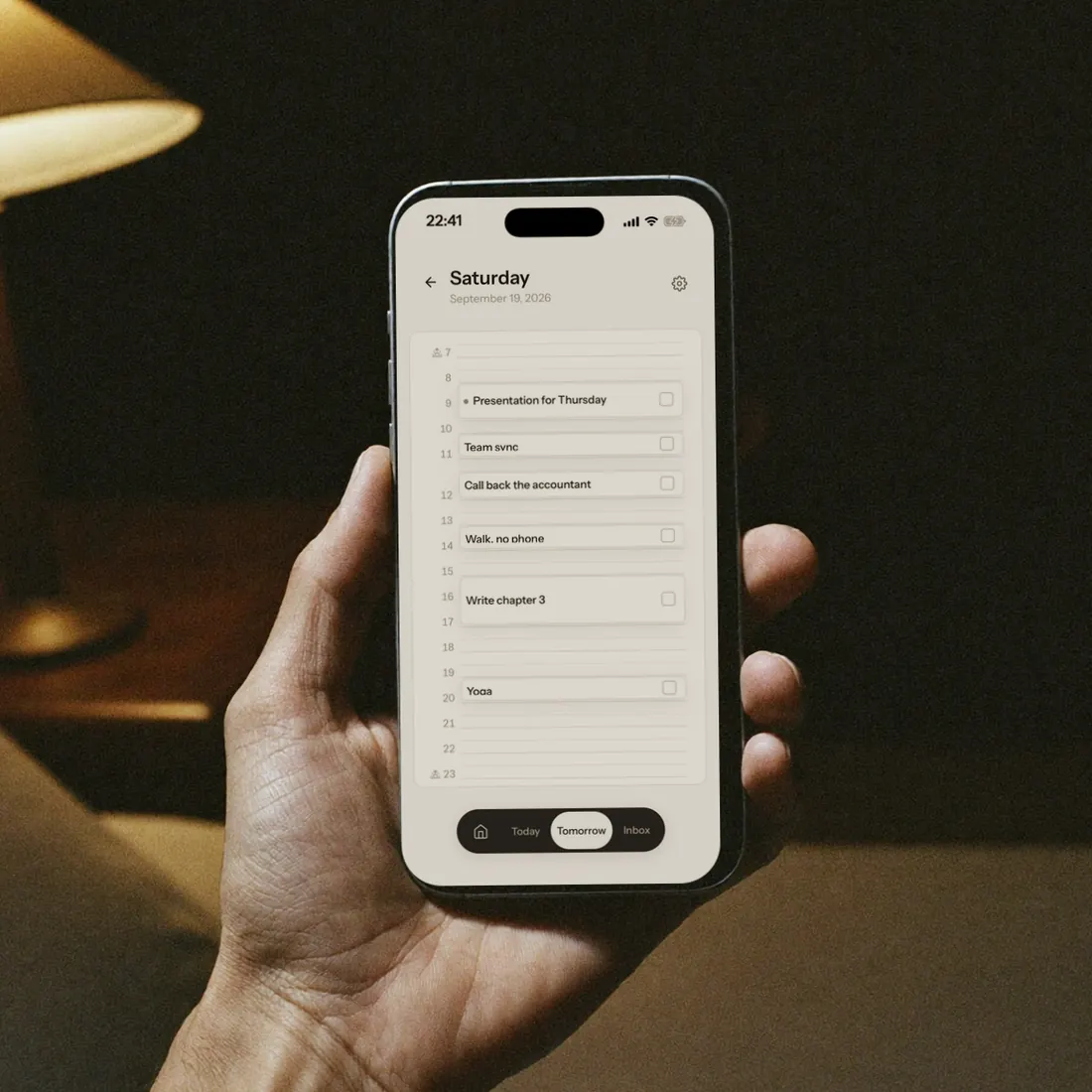
That's what TOMRW walks you through. Tick off today. One thing for tomorrow. Give it a time. Phone down.

Why you'll get more done tomorrow.
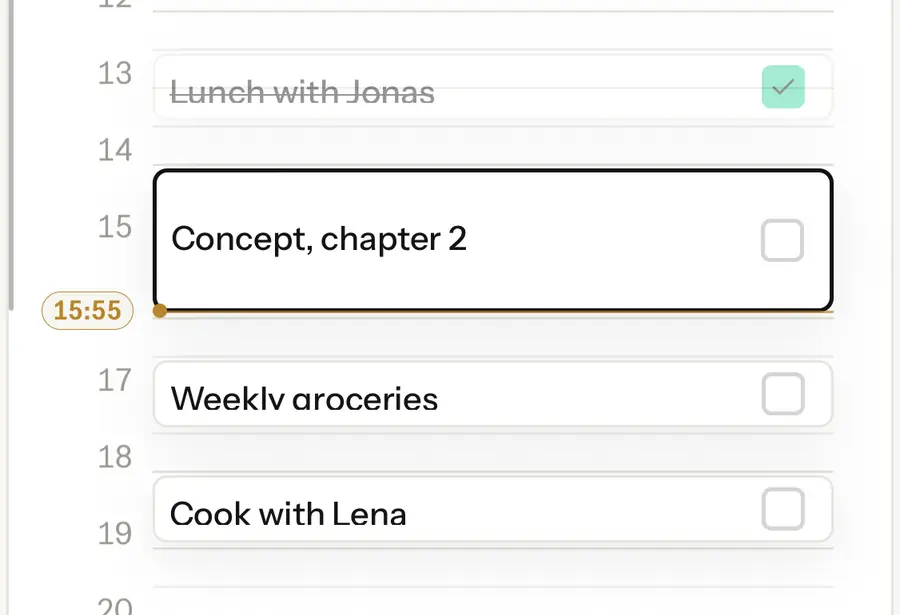
Timeboxing. Every task gets a fixed block in your day instead of a spot on a list. Out of 100 productivity techniques, it ranked number one, as published in the Harvard Business Review.
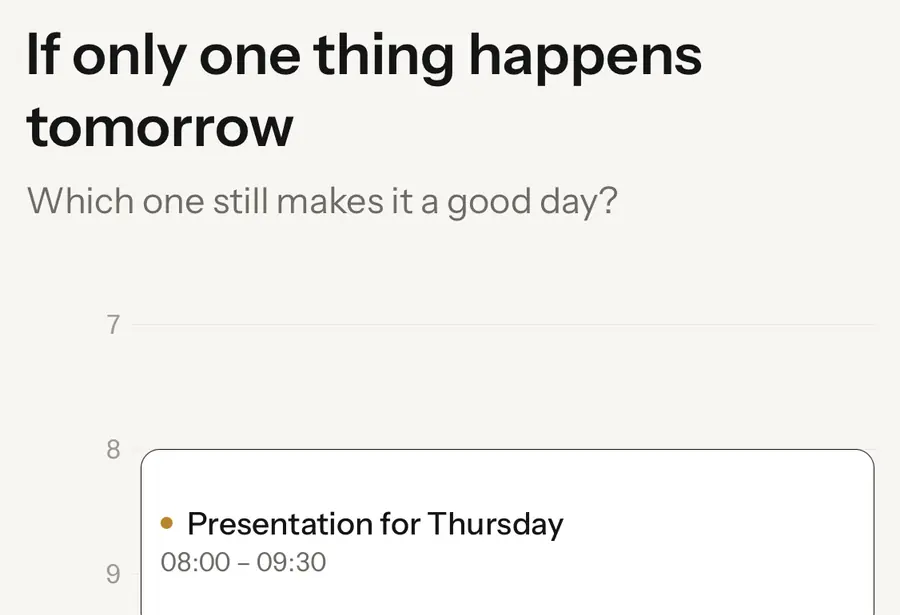
The difference is small and huge. At 9:00, 'presentation' isn't on a list. At 9:00 you start. And at 9:30 you notice if you're still in your inbox.
No week view, no backlog staring at you. Just today and tomorrow. Everything else waits in the inbox until it's up.
Not our opinion. Studies.
Four things TOMRW is built on.
-
Write tomorrow's tasks down for five minutes before bed and you fall asleep faster. About nine minutes on average. Sleep lab, 57 adults.
Scullin, Krueger, Ballard, Pruett & Bliwise (2018), Journal of Experimental Psychology: General, 147(1), 139–146.
-
Make a concrete plan for an open task and you think about it far less afterwards. Your head lets go.
Masicampo & Baumeister (2011), Journal of Personality and Social Psychology, 101(4), 667–683.
-
Decide in advance when and where you'll do something and you do it far more often. 94 studies, over 8,000 people.
Gollwitzer & Sheeran (2006), Advances in Experimental Social Psychology, 38, 69–119.
-
Timeboxing ranked first out of 100 productivity techniques in a survey by Filtered, published in the Harvard Business Review.
Zao-Sanders (2018), Harvard Business Review, How Timeboxing Works and Why It Will Make You More Productive. Ranking by Filtered.
TOMRW is a planner, not therapy and not a sleep aid.
Questions
What actually happens at night?
You open the app. It shows today: tick off what's done, move the rest to tomorrow. Then it asks for the one thing that matters tomorrow. You give it a time, add two or three blocks, done. Two minutes, honestly.
Do I need an account?
No. Without one, everything stays on your phone. You only need an account for TOMRW Cloud, which is backup and moving to a new phone. Sign-in is a code to your email, no password.
Is it good for ADHD?
It's built for heads that big calendars stress out: two days instead of a month, one decision at a time, every task with a visible time. It's a planner, not a treatment.
Can I cancel any time?
Yes, in the App Store or Google Play, two taps. You keep access until the paid period ends. Lifetime is a one-time purchase, nothing to cancel.
Try it free tonight.
7 days free. iPhone, iPad, Android.